
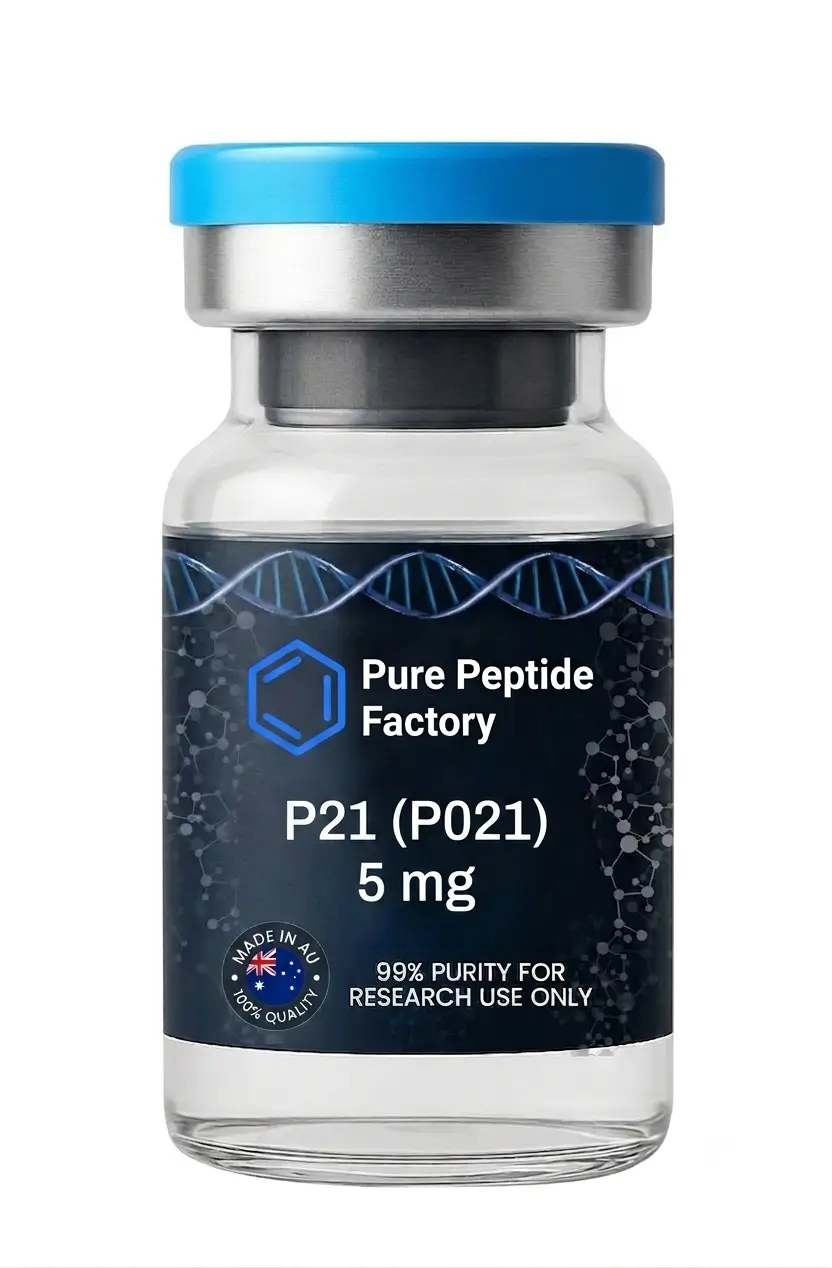
P21 (P021) 5 mg
Original price was: $130.00.$120.00Current price is: $120.00.
P21 5w research-grade peptide for laboratory applications. 5mg lyophilised vial with HPLC-verified purity. Minimum order $200 AUD with domestic shipping. Not for human consumption.
P21 5w Research and Mechanism
P21 5w is a synthetic tetrapeptide (Ac-DGGLAG-NH2) engineered as a mimetic of ciliary neurotrophic factor (CNTF), a 22.7 kDa pluripotent neurotrophic factor that drives neuronal survival and differentiation. According to research published in PMC, P21 was developed through epitope mapping of Cerebrolysin to isolate the neurogenic activity of CNTF while eliminating adverse effects including anorexia, hyperalgesia and weight loss associated with full-length CNTF administration.citeweb_search:26#0 The peptide contains an adamantane modification at the C-terminal glycine that dramatically enhances blood-brain barrier penetration and metabolic stability, with a plasma half-life exceeding 6 hours compared to CNTF’s rapid clearance.
Research from Alzheimer’s Drug Discovery Foundation establishes that P21 competitively inhibits leukemia inhibitory factor (LIF) signalling, which normally suppresses neural progenitor cell differentiation. By blocking LIF, P21 promotes neurogenesis through CNTF signalling pathways and upregulates brain-derived neurotrophic factor (BDNF) expression via the TrkB-PI3K-AKT pathway.citeweb_search:26#7 A comprehensive monograph from Peptide Biologix documents that P21 increases Ki-67+ neural progenitor proliferation, elevates doublecortin (DCX) immature neuron markers, upregulates BDNF protein levels by 40 to 60 percent, increases TrkB receptor expression, elevates pCREB/CREB ratio 2 to 3 fold, and restores synaptic proteins including synaptophysin and synapsin I in deficit models.citeweb_search:26#4 It is critical to emphasise that P21 is not approved by the TGA or FDA for human use. It is sold strictly for in vitro and laboratory research use only.
P21 Peptide Research Applications
Neurodegenerative Disease Research
According to Peptide Biologix, P21 serves as a valuable research tool for investigating neuroplasticity mechanisms, neurogenesis regulation, and potential therapeutic interventions in neurodegenerative diseases.citeweb_search:26#4 Its well-characterised effects on BDNF/TrkB/CREB signalling make it useful for mechanistic studies exploring how neurotrophic enhancement can compensate for pathological processes in Alzheimer’s disease, Parkinson’s disease, and other conditions characterised by synaptic dysfunction and neuronal loss. In triple-transgenic Alzheimer’s mice (3xTg-AD), P21 treatment initiated at 9 to 10 months and continued for 6 to 12 months rescued neurogenesis deficits, restored synaptic density to near-normal levels, normalised BDNF and glutamate receptor expression, and reversed cognitive impairments on multiple memory tasks. Notably, these benefits occurred without reducing amyloid plaque burden or tau pathology, indicating P21 operates through synaptic compensation rather than primary disease pathology modification.
Traumatic Brain Injury and Stroke Models
Research published in PMC demonstrated that P21 enhances neurogenesis and promotes neuronal plasticity in the hippocampus, with long-term studies up to 12 months showing no side effects.citeweb_search:26#0 The neuroprotective and neurorestorative effects demonstrated in TBI models position P21 as a research tool for investigating recovery mechanisms following acute brain injury. Studies can explore optimal timing of intervention, dose-response relationships, and combinations with other neuroprotective agents or rehabilitation strategies. Emerging research is exploring P21 in stroke models, where neurogenesis and synaptic plasticity contribute to functional recovery.
Cognitive Enhancement Research
According to Peptide Biologix, P21’s demonstrated cognitive enhancement in healthy animals makes it relevant for research into the neural basis of learning, memory, and cognitive optimisation.citeweb_search:26#4 Studies can examine how enhanced neurogenesis and synaptic plasticity translate to improved performance on specific cognitive tasks, identify neural circuits and molecular mechanisms underlying cognitive enhancement, and explore potential limits or tradeoffs of artificially enhanced plasticity. The compound provides a pharmacological tool for testing hypotheses about neurogenesis contributions to different forms of memory, pattern separation, cognitive flexibility, and emotional regulation.
P21 5w Dosage and Reconstitution
P21 5w Dose for Research Protocols
For laboratory research, P21 5w is typically supplied as a 5mg lyophilised powder. According to research protocol references, optimal cognitive enhancement in preclinical models was observed at 0.1 to 1.0 mg per kg administered daily for 2 to 4 weeks.citeweb_search:26#4 For in vitro applications, working concentrations of 10 to 100 nanomolar are common reference points for studying BDNF/TrkB signalling, neurogenesis markers, and synaptic protein expression. Long-term studies in 3xTg-AD mice used chronic administration over 6 to 12 months with no observed adverse effects. Gently swirl the vial until fully dissolved. Do not shake vigorously. Allow the solution to settle at room temperature before aliquoting.
Reconstitution Guide
Remove the vial from freezer storage and allow it to equilibrate to room temperature for 15 to 20 minutes. Draw 1.0 to 2.0 mL of bacteriostatic water into a sterile syringe and inject slowly down the inner vial wall to minimise foaming. Gently swirl until fully dissolved. Label with the reconstitution date and store at 2 to 8 degrees C protected from light. Use within 14 to 21 days. Do not freeze reconstituted solution.
How P21 Compares to Other Research Compounds
P21 vs Cerebrolysin
Cerebrolysin is a complex porcine brain-derived peptide hydrolysate containing multiple neurotrophic factors including BDNF-like and NGF-like peptides. P21 is a single defined tetrapeptide engineered from CNTF residues 147 to 150 with adamantane modification. Cerebrolysin offers broad-spectrum neurotrophic activity but with complex, undefined composition. P21 provides precise, mechanistically characterised neurogenesis promotion with defined molecular targets. For researchers requiring batch-to-batch consistency and known mechanism, P21 is preferable. For researchers studying complex multi-factor neurotrophic environments, cerebrolysin may be more appropriate.
P21 vs Semax
Semax is a synthetic heptapeptide derived from ACTH, studied for cognitive enhancement through BDNF upregulation and dopaminergic modulation. P21 is a CNTF-derived tetrapeptide studied for neurogenesis promotion through LIF inhibition and BDNF/TrkB/CREB signalling. Semax primarily enhances focus, attention, and neuroprotection in acute and subchronic models. P21 promotes structural neurogenesis, synaptic restoration, and long-term cognitive compensation even in established pathology. For acute cognitive enhancement research, semax may be preferable. For neurogenesis and structural plasticity research, P21 offers a distinct mechanistic profile.
P21 vs Selank
Selank is a synthetic heptapeptide derived from tuftsin, studied for anxiolytic effects and stress adaptation through GABAergic modulation. P21 is a CNTF-derived tetrapeptide studied for neurogenesis and synaptic plasticity through BDNF upregulation. Selank addresses emotional regulation and stress resilience; P21 addresses structural brain repair and cognitive compensation. They are complementary research tools with entirely different primary mechanisms.
P21 vs BPC-157
BPC-157 is a synthetic gastric pentapeptide primarily researched for tissue regeneration, angiogenesis, and gut healing through growth factor modulation. P21 is a CNTF-derived tetrapeptide studied for neurogenesis, synaptic restoration, and cognitive enhancement through BDNF/TrkB signalling. BPC-157 addresses peripheral and gastrointestinal repair; P21 addresses central nervous system plasticity. They are distinct research compounds with different primary applications.
P21 vs 5 Amino 1mq
5 amino 1mq is a small molecule NNMT inhibitor studied for metabolic regulation through NAD+ and SIRT1 pathways in adipose tissue. P21 is a peptide-based neurotrophic compound studied for neurogenesis and synaptic plasticity through CNTF/BDNF signalling. 5 amino 1mq addresses cellular energy balance; P21 addresses neural regeneration. They are not interchangeable research compounds.
P21 vs AOD-9604
AOD-9604 is a modified HGH fragment studied for direct lipolysis via beta-3 adrenergic receptor pathways. P21 is a CNTF-derived peptide with no lipolytic mechanism. AOD-9604 is positioned for fat metabolism research; P21 is positioned for neurogenesis and cognitive enhancement research. They are entirely different research compounds.
P21 vs MOTS-c
MOTS-c is a mitochondrial-derived peptide that activates AMPK and regulates cellular energy homeostasis. P21 is a CNTF-derived peptide that promotes neurogenesis and synaptic plasticity through BDNF upregulation. MOTS-c is studied for metabolic adaptation and exercise mimetics; P21 is studied for neural regeneration and cognitive compensation. These are entirely different research categories.
P21 vs Hgh Fragment 176 191
Hgh fragment 176 191 is a peptide fragment targeting the lipolytic domain of human growth hormone, studied for fat metabolism. P21 is a CNTF-derived tetrapeptide with no structural relationship to growth hormone. Hgh fragment 176 191 is investigated for subcutaneous fat reduction; P21 is investigated for neurogenesis and cognitive enhancement. They are entirely different research tools.
Product Specifications
Purity and Analysis
- Content: 5mg lyophilised powder
- Sequence: Ac-DGGLAG-NH2 with adamantane modification
- Chemical Name: N-acetyl-DGGLAG-amide adamantane conjugate
- Molecular Formula: C22H34N6O7
- Molecular Weight: 494.5 g/mol
- Purity: Greater than or equal to 98% by HPLC
- Appearance: White to off-white lyophilised powder
- Source: Synthetic, manufactured via solid-phase peptide synthesis
Each batch is independently tested. Request the Certificate of Analysis (COA) for your specific batch number to verify purity, mass spec, and chromatography data.
Storage and Handling
- Lyophilised storage: -20 degrees C, protected from light and moisture
- Shelf life (unreconstituted): 24 months when stored correctly
- Handling: Use sterile technique. Avoid repeated freeze-thaw cycles
Shipping and Returns
We ship P21 5w from our Australian facility via express domestic courier. Orders placed before 2:00 PM AEST dispatch the same business day. All orders are packaged in insulated, discreet packaging with cold-chain protection where required.
- Minimum order: $200 AUD
- Free shipping: Orders over $200 AUD
- Flat rate: $15 AUD for orders under $200
- Delivery time: 1 to 5 business days Australia-wide
- Returns: Unopened vials may be returned within 30 days of delivery for store credit or replacement. We do not accept returns on reconstituted or opened products due to stability concerns. Read the full returns policy.
Frequently Asked Questions
P21 5w what is it
P21 5w is a research-grade tetrapeptide mimetic of ciliary neurotrophic factor (CNTF) with adamantane modification for enhanced blood-brain barrier penetration. It is studied for neurogenesis promotion, synaptic plasticity, and cognitive enhancement in laboratory models.
P21 peptide for research
Pure Peptide Factory supplies P21 peptide as a 5mg lyophilised vial for laboratory research. Each batch is HPLC verified and ships with a Certificate of Analysis. Minimum order $200 AUD.
P21 skills what does it mean
P21 skills is not related to this peptide product. It refers to 21st-century learning skills frameworks in education. Pure Peptide Factory supplies P21 (P021) peptide for neurobiology research only.
P21 5w bulb vs P21/5w bulb
P21 5w bulb and P21/5w bulb refer to automotive lighting products, not research peptides. Pure Peptide Factory supplies P21 (P021) peptide for laboratory neurobiology research.
Durapro P21 what is it
Durapro P21 is an automotive bulb brand, not a research peptide. Pure Peptide Factory supplies P21 (P021) tetrapeptide for neurogenesis and cognitive research.
Narva P21/5w 12v what is it
Narva P21/5w 12v is an automotive dual-filament bulb, not a research peptide. Pure Peptide Factory supplies P21 (P021) peptide for laboratory research.
23623 P21 315 what is it
23623 P21 315 is an automotive bulb specification, not a research peptide. Pure Peptide Factory supplies P21 (P021) peptide for neurobiology research.
P21 5mg dosage for research
Preclinical models typically use 0.1 to 1.0 mg per kg daily for 2 to 4 weeks. In vitro work commonly uses 10 to 100 nanomolar. All dosing is for laboratory research only.
Is P21 approved for human use
No. P21 is strictly for research and laboratory use. It is not approved by the TGA for human consumption, therapeutic application, or clinical use.
Do you ship outside Australia
Currently, we only ship to Australian addresses. We do not export research compounds due to varying international customs regulations.
How do I verify the purity of my batch
Every batch ships with a unique batch number. Enter this number on our COA lookup page to download the HPLC and mass spec report for your specific vial.
Related products
-
Adamax 10MG
Original price was: $70.00.$60.00Current price is: $60.00.
Reviews
There are no reviews yet.