
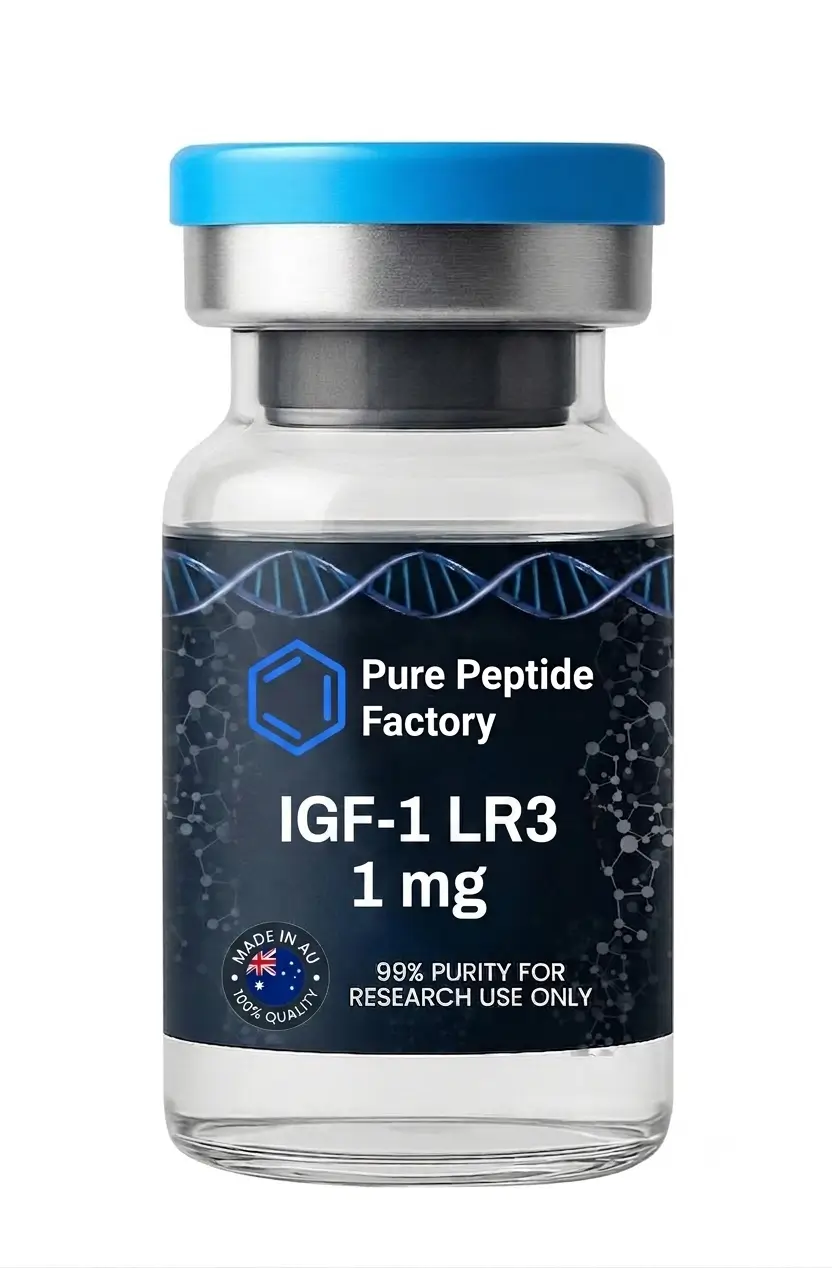
IGF-1 LR3 1 mg
Price range: $30.00 through $90.00
Igf-1 lr3 research-grade peptide for laboratory applications. Available in 1mg lyophilised vials with HPLC-verified purity. Minimum order $200 AUD with domestic shipping. Not for human consumption.
Igf-1 Lr3 Research and Mechanism
Igf-1 lr3 is an 83-amino-acid synthetic analogue of native insulin-like growth factor-1 with two key modifications: a 13-amino-acid extension at the N-terminus and an arginine substitution for glutamic acid at position 3. According to structural research data from Maple Research Labs, these modifications significantly reduce binding to insulin-like growth factor binding proteins (IGFBPs), resulting in a dramatically extended half-life of approximately 20 to 30 hours compared to native IGF-1’s 10 to 20 minutes.citeweb_search:18#2 This extended bioavailability makes igf-1 lr3 a valuable tool for studying sustained receptor activation and long-term growth factor signalling in laboratory models.
Research published in MediSearch indicates that igf-1 lr3 activates the IGF1R/IRS1/PI3K/Akt cascade, leading to skeletal muscle hypertrophy through enhanced protein synthesis, increased mesenchymal stem cell proliferative potential, and inhibition of muscle proteolysis.citeweb_search:18#7 The compound also demonstrates insulin-mimetic effects on glucose transport, which researchers must account for in metabolic assay design. It is critical to emphasise that igf-1 lr3 is not approved by the TGA or FDA for human use. It is sold strictly for in vitro and laboratory research use only.
Igf-1 Lr3 Dosage and Reconstitution
Dosage for Igf-1 Lr3 Research Protocols
For laboratory research, igf 1 lr3 is typically supplied as a 1mg lyophilised powder. According to research protocol references, typical laboratory dosing ranges from 20 to 100 micrograms per day in preclinical models, with administration once daily due to the compound’s extended half-life.citeweb_search:18#0 For in vitro applications, working concentrations of 1 to 100 nanograms per mL in cell culture media are common reference points for studying IGF-1 receptor signalling, myoblast differentiation, and metabolic pathway activation. Researchers investigating dosage for igf-1 lr3 should note that the compound reduces glucose transport into cells, potentially triggering hypoglycaemic effects in in vivo models. Gently swirl the vial until fully dissolved. Do not shake vigorously. Allow the solution to settle at room temperature before aliquoting.
Dosing Igf 1 Lr3 Reconstitution Guide
Remove the vial from freezer storage and allow it to equilibrate to room temperature for 15 to 20 minutes. Draw 1.0 to 2.0 mL of bacteriostatic water into a sterile syringe and inject slowly down the inner vial wall to minimise foaming. Gently swirl until fully dissolved. Label with the reconstitution date and store at 2 to 8 degrees C protected from light. Use within 14 to 21 days. Do not freeze reconstituted solution.
Igf 1 Lr3 Peptide Side Effects in Research Literature
Research literature documents several potential adverse effects associated with igf 1 lr3 peptide. According to MediSearch, the primary risks include hypoglycaemia due to insulin-mimetic glucose transport inhibition, and potential cell proliferation concerns given IGF-1’s role as a growth factor.citeweb_search:18#7 A study referenced in the same source found that muscle mass increased but muscle strength declined in parallel, suggesting complex physiological effects beyond simple anabolism.citeweb_search:18#7 These safety profiles are documented for research reference only and do not constitute medical guidance. Researchers should handle igf-1 lr3 with appropriate biosafety protocols and calibrated dosing equipment.
How Igf-1 Lr3 Compares to Other Research Compounds
Igf-1 Lr3 vs Igf-1 Des
IGF-1 DES is a truncated 67-amino-acid IGF-1 variant lacking the first three N-terminal amino acids. According to comparative research data, IGF-1 DES has higher intrinsic affinity for the IGF-1 receptor but a much shorter half-life of 20 to 30 minutes.citeweb_search:18#2 Igf-1 lr3 provides sustained systemic activation over 20 to 30 hours, making it preferable for chronic exposure studies, extended pathway activation research, and long-term cell culture experiments. IGF-1 DES is better suited for acute signalling studies, pulse-chase experiments, and protocols requiring precise temporal control. For researchers studying sustained IGF-1 receptor activation without frequent re-dosing, igf-1 lr3 is the appropriate tool.
Igf-1 Lr3 vs Hgh Fragment 176 191
Hgh fragment 176 191 is a modified HGH fragment studied for lipolysis via beta-3 adrenergic receptor pathways without significant IGF-1 elevation. Igf-1 lr3 is a direct IGF-1 receptor agonist that promotes protein synthesis, cell proliferation, and muscle hypertrophy through the PI3K/Akt/mTOR pathway. Hgh fragment 176 191 is investigated for fat metabolism research, while igf-1 lr3 is investigated for growth factor signalling, cell differentiation, and tissue regeneration. They are distinct research tools with different receptor targets and mechanistic profiles.
Igf-1 Lr3 vs BPC-157
BPC-157 is a synthetic gastric pentapeptide primarily researched for tissue regeneration, angiogenesis, and gut healing through growth factor modulation. Igf-1 lr3 is a direct growth factor receptor agonist that activates IGF-1R signalling to drive cell proliferation and protein synthesis. BPC-157 works indirectly through VEGF and NO pathways, while igf-1 lr3 acts directly on the IGF-1 receptor axis. For growth factor pathway research, igf-1 lr3 provides direct receptor activation. For tissue repair and angiogenesis studies, BPC-157 offers a different mechanistic approach.
Igf-1 Lr3 vs AOD-9604
AOD-9604 is a modified HGH fragment studied for direct lipolysis via beta-3 adrenergic receptor pathways without IGF-1 effects. Igf-1 lr3 is a direct IGF-1 receptor agonist with potent anabolic signalling properties. AOD-9604 is positioned for fat metabolism research, while igf-1 lr3 is positioned for growth factor signalling, cell proliferation, and protein synthesis research. They are entirely different research compounds with no mechanistic overlap.
Igf-1 Lr3 vs 5 Amino 1mq
5 amino 1mq is a small molecule NNMT inhibitor studied for metabolic regulation through NAD+ and SIRT1 pathways in adipose tissue. Igf-1 lr3 is a peptide-based growth factor receptor agonist that drives cell proliferation and protein synthesis. 5 amino 1mq addresses cellular energy balance and metabolic efficiency, while igf-1 lr3 addresses growth factor signalling and tissue anabolism. They are not interchangeable research compounds.
Igf-1 Lr3 vs MOTS-c
MOTS-c is a mitochondrial-derived peptide that activates AMPK and regulates cellular energy homeostasis through metabolic stress response. Igf-1 lr3 is an endocrine growth factor analog that activates the IGF-1 receptor to drive cell proliferation and protein synthesis. MOTS-c is studied for metabolic adaptation and exercise mimetics, while igf-1 lr3 is studied for growth factor biology and tissue anabolism. These are complementary but non-overlapping research categories.
Product Specifications
Purity and Analysis
- Content: 1mg lyophilised powder
- Sequence: 83-amino-acid IGF-1 analogue with N-terminal extension and Arg3 substitution
- Molecular Formula: C400H625N111O115S8
- Molecular Weight: 9117.6 g/mol
- Purity: Greater than or equal to 98% by HPLC
- Appearance: White to off-white ly
| Dosage | 0.1mg, 1mg |
|---|
Related products
-
Glow Blend 70mg
Original price was: $168.00.$158.00Current price is: $158.00.
Reviews
There are no reviews yet.