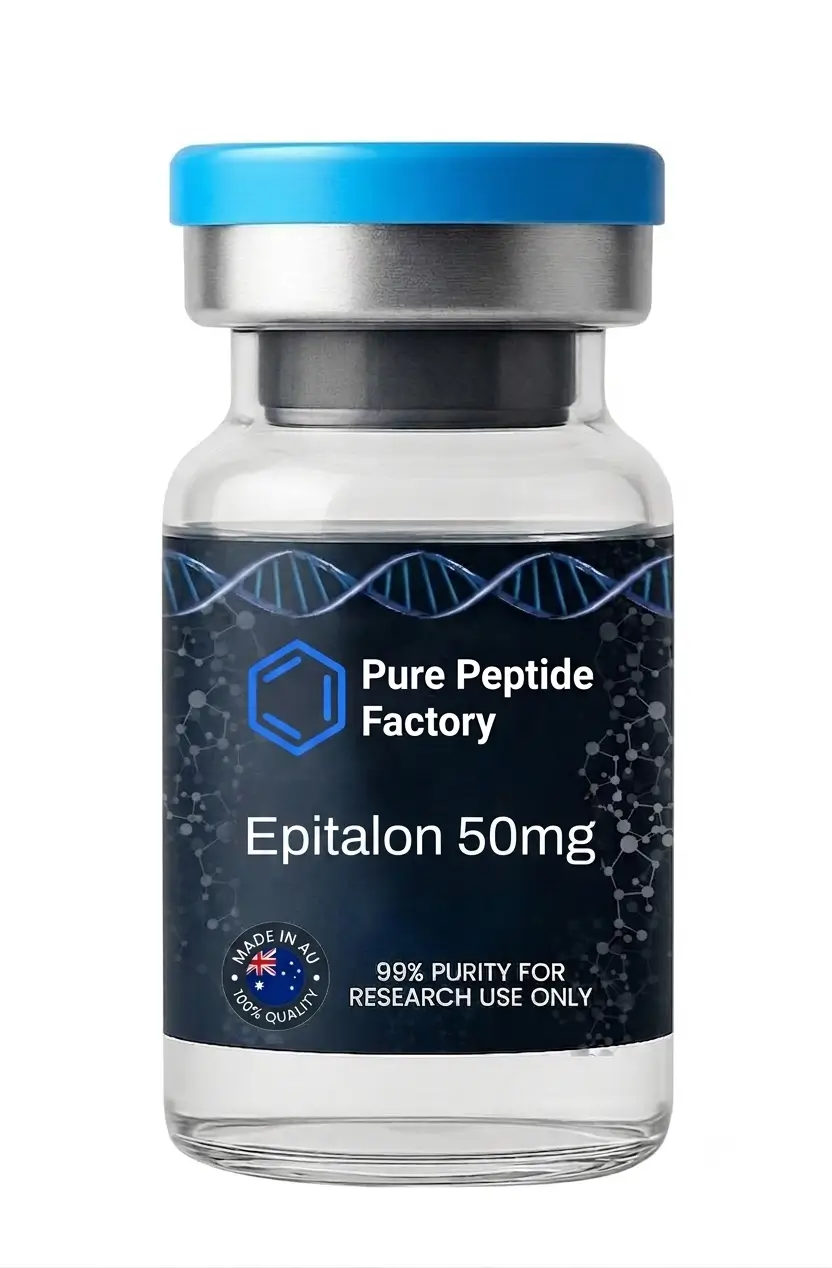
Epitalon peptide 50mg
Price range: $25.00 through $65.00
Buy epitalon peptide australia research-grade pineal tetrapeptide for laboratory applications. Available in 10mg lyophilised vials with HPLC-verified purity. Minimum order $200 AUD with domestic shipping. Not for human consumption.
Buy Epitalon Peptide Australia Research and Mechanism
Buy epitalon peptide australia for laboratory research into telomere biology, pineal gland signalling, and cellular longevity pathways. Epitalon, also known as Epithalon or AEDG, is a synthetic tetrapeptide with the sequence Ala-Glu-Asp-Gly developed from the amino acid composition of Epithalamin. According to research published in MDPI, Epitalon was first detected in physiological pineal gland extract in 2017 and shares properties with its natural progenitor Epithalamin, though differing in the intensity of some actions.citeweb_search:11#6 This pineal-derived peptide is a tool for studying telomerase activation, circadian rhythm modulation, and geroprotective mechanisms in preclinical models.
Research published in PMC demonstrates that Epitalon increases telomere length in human cell lines through dose-dependent upregulation of hTERT mRNA expression and telomerase enzyme activity. In normal epithelial and fibroblast cells, telomere extension occurred specifically through telomerase upregulation, while cancer cells showed extension via ALT (Alternative Lengthening of Telomeres) activation.citeweb_search:9#1 Additional PMC research confirms that Epitalon modulates pineal gland function, restoring nocturnal melatonin production and circadian gene expression including Clock, Cry2, and Csnk1e in aged animal models.citeweb_search:9#0 It is critical to emphasise that epitalon peptide is not approved by the TGA for human use. It is sold strictly for in vitro and laboratory research use only.
Epitalon vs Thymalin Research Comparison
Epitalon vs Thymalin Mechanism
According to geroprotective research published in PubMed, Thymalin and Epithalamin (the natural precursor to Epitalon) were clinically assessed in 266 elderly persons over 6-8 years. Thymalin treatment produced a 2.0-2.1-fold decrease in mortality versus controls, Epithalamin produced a 1.6-1.8-fold decrease, and combined treatment produced a 2.5-fold decrease.citeweb_search:10#8 PMC research on Thymalin demonstrates that Thymalin acts primarily through thymic and hematopoietic pathways, stimulating proliferation and reducing cell apoptosis by 29-42% in spleen tissue explants.citeweb_search:10#4
For research applications, epitalon vs thymalin selection depends on experimental design. Thymalin is preferred for immune restoration, hematopoiesis regulation, and immunosenescence research. Epitalon is preferred for telomere maintenance, pineal neuroendocrine signalling, and genomic stability studies.citeweb_search:10#7web_search:10#8
Epitalon vs NAD+ Research
Researchers frequently investigate epitalon vs NAD+ because the two compounds address distinct hallmarks of aging through fundamentally different mechanisms. According to comparative longevity research, Epitalon targets genomic stability through telomerase activation and telomere maintenance, while NAD+ targets metabolic integrity through sirtuin activation, PARP-mediated DNA repair, and mitochondrial function.citeweb_search:11#3 Epitalon is a tetrapeptide that binds to cellular signalling pathways to induce hTERT expression; NAD+ is a dinucleotide coenzyme required as a substrate for over 500 enzymatic reactions governing cellular energy production. For laboratory research, Epitalon is positioned for telomere biology and chromatin remodelling studies, while NAD+ is positioned for metabolic ageing, deregulated nutrient sensing, and mitochondrial bioenergetics research.
Epitalon vs GHK-Cu Research
The epitalon vs GHK-Cu comparison highlights two different approaches to longevity peptide research. According to research published in PMC on therapeutic peptides in gerontology, Epitalon is classified as a telomere biology peptide that activates telomerase to extend cellular replicative lifespan. GHK-Cu is a naturally occurring copper tripeptide studied for dermal regeneration, collagen synthesis, and gene expression modulation across thousands of human genes.citeweb_search:10#1 Epitalon extends the Hayflick limit in fibroblast cultures; GHK-Cu stimulates fibroblast activity and angiogenesis in wound healing models. These are complementary research tools targeting different ageing pathways.
Epitalon vs BPC-157 Research
According to gerontological peptide research, Epitalon and BPC-157 occupy distinct categories in longevity science. Epitalon is a pineal tetrapeptide investigated for telomerase activation, melatonin regulation, and lifespan extension. BPC-157 is a synthetic pentadecapeptide investigated for tissue regeneration, angiogenesis, and musculoskeletal repair through growth factor pathways.citeweb_search:10#1 BPC-157 is preferred for structural repair and wound healing research. Epitalon is preferred for chromosomal stability, neuroendocrine, and cellular senescence research. They are not interchangeable compounds.
Epitalon Peptide Benefits in Research
Research applications involving epitalon peptide benefits span telomere biology, neuroendocrine regulation, and antioxidant defence. According to comprehensive PMC research, Epitalon has demonstrated telomerase activation in human somatic cells, increased telomere length by an average of 33.3% in lymphocyte cultures, extended cellular lifespan beyond the Hayflick limit in fibroblast models, and reduced senescence markers p16 and p21 in periodontal ligament stem cells.citeweb_search:9#0 Additional research directions include pineal gland protection against oxidative stress, restoration of circadian melatonin rhythms, reduced spontaneous tumor incidence in rodent models, and improved mitochondrial membrane potential in oocyte maturation studies.citeweb_search:9#1web_search:9#0 These effects are observed in preclinical and theoretical models; epitalon has not been approved for human therapeutic use.
Epitalon Peptide Dosage and Reconstitution
Epitalon Dose for Research Protocols
For laboratory research, epitalon peptide is typically supplied as a 10mg lyophilised powder. According to research protocol references, typical laboratory protocols involve 5mg daily via subcutaneous injection for 20 consecutive days, or 10mg daily for 10 days, followed by an off-cycle of 4 to 6 months before repeating.citeweb_search:10#2 Reconstitution with 2.0 mL of bacteriostatic water yields a concentration of 5mg/mL, where 1 unit on a U-100 insulin syringe (0.01 mL) delivers 50 micrograms. Evening administration is recommended to align with natural melatonin rhythms. All dosing parameters are for laboratory research use only and must be calibrated to specific assay requirements.
Reconstitution Guide
Remove the vial from freezer storage and allow it to equilibrate to room temperature for 15 to 20 minutes. Draw 2.0 mL of bacteriostatic water into a sterile syringe and inject slowly down the inner vial wall to minimise foaming. Gently swirl until fully dissolved. Do not shake vigorously. Label with the reconstitution date and store at 2 to 8 degrees C protected from light. Use within 14 to 21 days. Do not freeze reconstituted solution.
How Epitalon Compares to Other Research Compounds
Epitalon vs Thymalin
Thymalin is a thymic peptide studied for immune restoration, T-cell maturation, and hematopoiesis regulation. Epitalon peptide is a pineal tetrapeptide studied for telomerase activation and pineal neuroendocrine signalling. Thymalin is preferred for immunosenescence and immune cell apoptosis research. Epitalon is preferred for telomere maintenance and genomic stability research. They are complementary geroprotective tools.
Epitalon vs NAD+
NAD+ is a dinucleotide coenzyme studied for metabolic integrity, sirtuin activation, and mitochondrial bioenergetics. Epitalon peptide is a tetrapeptide studied for telomerase activation and chromosomal stability. NAD+ addresses deregulated nutrient sensing. Epitalon addresses telomere attrition. These are distinct but complementary longevity research categories.
Epitalon vs GHK-Cu
GHK-Cu is a copper tripeptide studied for dermal regeneration, collagen synthesis, and gene expression modulation. Epitalon peptide is a pineal tetrapeptide studied for telomere lengthening and cellular replicative lifespan. GHK-Cu is positioned for tissue remodelling and wound healing research. Epitalon is positioned for chromosomal maintenance and senescence delay research. They operate through entirely different mechanisms.
Epitalon vs BPC-157
BPC-157 is a synthetic pentadecapeptide studied for musculoskeletal repair, angiogenesis, and tissue regeneration. Epitalon peptide is a pineal tetrapeptide studied for telomerase activation and neuroendocrine regulation. BPC-157 is for structural repair research. Epitalon is for genomic and circadian research. These are distinct research compounds.
Epitalon vs CJC-1295 No Dac
CJC-1295 No DAC is a GHRH analog studied for growth hormone axis stimulation and pulsatile GH release. Epitalon peptide is a pineal tetrapeptide studied for telomere maintenance and melatonin regulation. CJC-1295 No DAC addresses the somatotropic axis. Epitalon addresses chromosomal and neuroendocrine ageing pathways. These are entirely different endocrine research categories.
Epitalon vs Glutathione
Glutathione is a tripeptide antioxidant studied for cellular redox balance, detoxification, and antioxidant enzyme cofactor activity. Epitalon peptide is a tetrapeptide studied for telomerase activation and pineal gland regulation. Glutathione is positioned for oxidative stress and phase II detoxification research. Epitalon is positioned for genomic stability and longevity signalling research. They are not interchangeable research tools.
Product Specifications
Purity and Analysis
- Content: 10mg lyophilised powder
- Sequence: Ala-Glu-Asp-Gly (AEDG)
- Molecular Formula: C₁₄H₂₂N₄O₉
- Molecular Weight: 390.35 g/mol
- Purity: Greater than or equal to 98% by HPLC
- Appearance: White to off-white lyophilised powder
- Source: Synthetic, manufactured via solid-phase peptide synthesis
Each batch is independently tested. Request the Certificate of Analysis (COA) for your specific batch number to verify purity, mass spec, and chromatography data.
Storage and Handling
- Lyophilised storage: -20 degrees C, protected from light and moisture
- Shelf life (unreconstituted): 24 months when stored correctly
- Handling: Use sterile technique. Avoid repeated freeze-thaw cycles
Shipping and Returns
We ship epitalon peptide from our Australian facility via express domestic courier. Orders placed before 2:00 PM AEST dispatch the same business day. All peptide orders are packaged in insulated, discreet packaging with cold-chain protection where required.
- Minimum order: $200 AUD
- Free shipping: Orders over $200 AUD
- Flat rate: $15 AUD for orders under $200
- Delivery time: 1 to 5 business days Australia-wide
- Returns: Unopened vials may be returned within 30 days of delivery for store credit or replacement. We do not accept returns on reconstituted or opened products due to stability concerns. Read the full returns policy.
Frequently Asked Questions
Buy epitalon peptide australia for research
Pure Peptide Factory supplies epitalon peptide as a research-grade pineal tetrapeptide for laboratory applications. Each vial contains 10mg lyophilised powder with HPLC verification and a Certificate of Analysis. Minimum order $200 AUD.
Epitalon vs thymalin for research
Thymalin is a thymic peptide for immune restoration and T-cell research. Epitalon is a pineal peptide for telomere maintenance and neuroendocrine research. They target different geroprotective pathways and are complementary tools.
Epitalon vs NAD+ mechanism
Epitalon activates telomerase to maintain telomere length and genomic stability. NAD+ is a coenzyme that fuels sirtuins and PARP enzymes for metabolic integrity and DNA repair. They address different hallmarks of ageing.
Epitalon peptide dosage for research
Research protocols typically use 5mg daily for 20 consecutive days or 10mg daily for 10 days, followed by a 4 to 6 month off-cycle. Reconstitute a 10mg vial with 2.0 mL bacteriostatic water to yield 5mg/mL. All dosing is for laboratory research only.
Epitalon vs GHK-Cu which is better
Neither is universally better. GHK-Cu is preferred for dermal regeneration, collagen synthesis, and tissue remodelling research. Epitalon is preferred for telomere biology, chromosomal stability, and cellular longevity research.
Is epitalon approved for human use
No. Epitalon peptide is strictly for research and laboratory use. It is not approved by the TGA for human consumption, therapeutic application, or clinical use.
Do you ship outside Australia
Currently, we only ship to Australian addresses. We do not export peptides due to varying international customs regulations.
How do I verify the purity of my batch
Every batch ships with a unique batch number. Enter this number on our COA lookup page to download the HPLC and mass spec report for your specific vial.
| Dosage | 10mg, 50mg |
|---|
Reviews
There are no reviews yet.