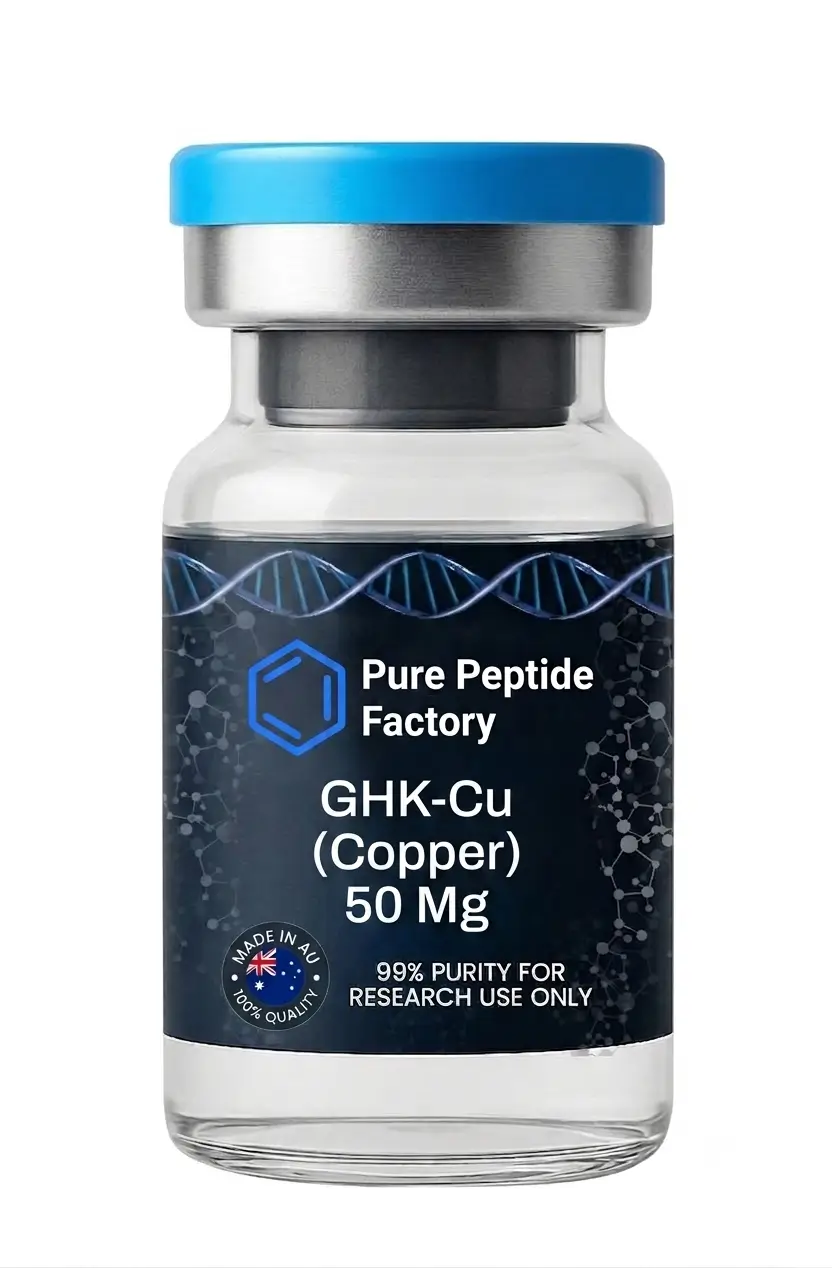
GHK-Cu (Copper) 50 Mg
Price range: $36.00 through $58.00
Copper peptide ghk-cu research-grade for laboratory applications. Available in 50mg lyophilised vials with HPLC-verified purity. Minimum order $200 AUD with domestic shipping. Not for human consumption.
Copper Peptide GHK-Cu Research and Mechanism
Copper peptide ghk-cu is a naturally occurring tripeptide complex composed of glycine, histidine and lysine bound to a copper ion. It was first isolated from human plasma in 1973 by Loren Pickart, who identified it as the factor responsible for restoring protein synthesis in aged liver tissue to levels observed in younger tissue. According to research published in PMC, copper peptide ghk-cu is present in human plasma at approximately 200 ng/mL at age 20 but declines to 80 ng/mL by age 60, coinciding with reduced regenerative capacity.citeweb_search:13#0 The same review documents that this compound accelerates wound healing, stimulates collagen and glycosaminoglycan synthesis, modulates metalloproteinase activity, and attracts immune and endothelial cells to injury sites.citeweb_search:13#0
Further research in PMC established that copper peptide ghk-cu upregulates approximately 59 percent of genes while suppressing 41 percent, essentially resetting gene expression patterns toward a healthier state.citeweb_search:13#1 The peptide activates the TGF-beta pathway, increases integrin expression, and restores replicative vitality to fibroblasts after radiation therapy. It also demonstrates anti-inflammatory properties by reducing TNF-alpha induced secretion of IL-6 and suppressing NF-kappaB activation.citeweb_search:13#0web_search:13#1 This product is sold strictly for in vitro and laboratory research use only. It is not approved by the TGA or FDA for human consumption, therapeutic use, or diagnosis.
Copper Peptide GHK-Cu Dosage and Reconstitution
Copper Peptide GHK-Cu Dose for Research Protocols
For laboratory research, copper peptide ghk-cu is typically supplied as a 50mg lyophilised powder. Preclinical studies have demonstrated biological activity at extremely low concentrations, with effects observed in the nanomolar range. Researchers investigating ghk cu copper peptide dosing typically reconstitute with 2.0 to 5.0 mL of bacteriostatic water to achieve a concentration of 10 to 25 mg per mL for analytical work. For cell culture applications, working concentrations of 0.1 to 10 micromolar are common reference points. Gently swirl the vial until fully dissolved. Do not shake vigorously. Allow the solution to settle at room temperature before aliquoting.
Reconstitution Guide
Remove the vial from freezer storage and allow it to equilibrate to room temperature for 15 to 20 minutes. Draw 2.0 to 5.0 mL of bacteriostatic water into a sterile syringe and inject slowly down the inner vial wall to minimise foaming. Gently swirl until fully dissolved. Label with the reconstitution date and store at 2 to 8 degrees C protected from light. Use within 14 to 21 days. Do not freeze reconstituted solution.
How Copper Peptide GHK-Cu Compares to Other Research Compounds
Copper Peptide GHK-Cu vs Copper Tripeptide-1
Copper tripeptide-1 vs ghk cu is a common search because the two names refer to the same compound. GHK-Cu is the international cosmetic ingredient designation for copper tripeptide-1. Both terms describe the glycyl-L-histidyl-L-lysine copper complex. Whether you search for copper tripeptide-1 or copper peptide ghk-cu, you are researching the identical molecule. Pure Peptide Factory supplies this compound as a lyophilised research vial under the name GHK-Cu.
Copper Peptide GHK-Cu vs Glow Blend
Glow blend contains GHK-Cu as one of its three components alongside BPC-157 and TB-500 in a 5:1:1 ratio. Copper peptide ghk-cu as an individual product provides pure, unmixed material for researchers who want to study the copper tripeptide in isolation or who need to control exact concentrations without the additional variables of a multi-peptide stack. For integrated regeneration research, glow blend offers convenience. For isolated GHK-Cu mechanism studies, the individual copper peptide ghk-cu vial is preferable.
Copper Peptide GHK-Cu vs BPC-157 TB-500
BPC-157 TB-500 is a dual-peptide stack focused on angiogenesis, cell migration and soft tissue repair. Copper peptide ghk-cu is a single tripeptide focused on collagen synthesis, gene expression modulation and extracellular matrix remodelling. BPC-157 TB-500 is typically studied for musculoskeletal injury and wound healing speed, while copper peptide ghk-cu is studied for skin density, elasticity, antioxidant defence and hair follicle biology. These are complementary research tools with different primary applications.
Copper Peptide GHK-Cu vs 5 Amino 1mq
5 amino 1mq is a small molecule NNMT inhibitor studied for metabolic regulation through NAD+ and SIRT1 pathways in adipose tissue. Copper peptide ghk-cu is a copper-binding tripeptide studied for tissue regeneration, collagen signalling and gene expression modulation. 5 amino 1mq addresses cellular energy balance, while copper peptide ghk-cu addresses structural repair and dermal biology. They are not interchangeable research compounds.
Copper Peptide GHK-Cu vs AOD-9604
AOD-9604 is a modified HGH fragment studied for direct lipolysis via beta-3 adrenergic receptor pathways. Copper peptide ghk-cu is a naturally occurring tripeptide with no lipolytic mechanism. AOD-9604 is positioned for fat metabolism research, while copper peptide ghk-cu is positioned for regenerative biology, skin structure and wound healing. They are distinct research tools with different receptor targets.
Copper Peptide GHK-Cu vs MOTS-c
MOTS-c is a mitochondrial-derived peptide that activates AMPK and regulates cellular energy homeostasis through metabolic stress response. Copper peptide ghk-cu is a copper tripeptide that modulates gene expression and extracellular matrix synthesis. MOTS-c is studied for exercise adaptation and glucose regulation, while copper peptide ghk-cu is studied for dermal regeneration, collagen remodelling and antioxidant defence. These are complementary but non-overlapping research categories.
Copper Peptide GHK-Cu vs Hgh Fragment 176 191
Hgh fragment 176 191 is a peptide fragment targeting the lipolytic domain of human growth hormone, studied for fat metabolism without IGF-1 effects. Copper peptide ghk-cu is a copper-binding tripeptide with no structural relationship to growth hormone. Hgh fragment 176 191 is investigated for subcutaneous fat reduction, while copper peptide ghk-cu is investigated for tissue regeneration and matrix synthesis. They are entirely different research compounds.
Product Specifications
Purity and Analysis
- Purity: Greater than or equal to 98% by HPLC
- Chemical name: Glycyl-L-histidyl-L-lysine copper(II) complex
- Sequence: Gly-His-Lys
- Molecular Formula: C14H24N6O4Cu
- Molecular Weight: 403.9 g/mol
- Appearance: Blue to purple lyophilised powder
- Source: Synthetic, manufactured via solid-phase peptide synthesis
Each batch is independently tested. Request the Certificate of Analysis (COA) for your specific batch number to verify purity, mass spec, and chromatography data.
Storage and Handling
- Lyophilised storage: -20 degrees C, protected from light and moisture
- Shelf life (unreconstituted): 24 months when stored correctly
- Handling: Use sterile technique. Avoid repeated freeze-thaw cycles
Shipping and Returns
We ship copper peptide ghk-cu from our Australian facility via express domestic courier. Orders placed before 2:00 PM AEST dispatch the same business day. All peptide orders are packaged in insulated, discreet packaging with cold-chain protection where required.
- Minimum order: $200 AUD
- Free shipping: Orders over $200 AUD
- Flat rate: $15 AUD for orders under $200
- Delivery time: 1 to 5 business days Australia-wide
- Returns: Unopened vials may be returned within 30 days of delivery for store credit or replacement. We do not accept returns on reconstituted or opened products due to stability concerns. Read the full returns policy.
Frequently Asked Questions
What is copper peptide ghk-cu
Copper peptide ghk-cu is a naturally occurring tripeptide composed of glycine, histidine and lysine bound to a copper ion. It is found in human plasma, saliva and urine, and is extensively studied for its role in collagen synthesis, wound healing, gene expression modulation and antioxidant defence.
Ghk cu copper peptides what is it
Ghk cu copper peptides refers to the same copper tripeptide-1 complex. It is a research-grade compound used in laboratory studies exploring skin regeneration, tissue repair and cellular signalling pathways.
Copper peptides ghk cu vs copper tripeptide-1
They are the same compound. GHK-Cu is the international cosmetic ingredient name for copper tripeptide-1. Both terms refer to the glycyl-L-histidyl-L-lysine copper complex.
Copper peptide ghk cu for research
Pure Peptide Factory supplies copper peptide ghk cu as a 50mg lyophilised vial for laboratory research. Each batch is HPLC verified and ships with a Certificate of Analysis.
Copper ghk cu dosage for research
Preclinical studies show biological activity at nanomolar concentrations. For cell culture work, 0.1 to 10 micromolar is a common reference range. For analytical reconstitution, 2.0 to 5.0 mL of bacteriostatic water per 50mg vial yields 10 to 25 mg per mL.
Is copper peptide ghk-cu approved for human use
No. Copper peptide ghk-cu is strictly for research and laboratory use. It is not approved by the TGA for human consumption, therapeutic application, or clinical use.
Do you ship outside Australia
Currently, we only ship to Australian addresses. We do not export peptides due to varying international customs regulations.
How do I verify the purity of my batch
Every batch ships with a unique batch number. Enter this number on our COA lookup page to download the HPLC and mass spec report for your specific vial.
| Dosage | 50mg, 100mg |
|---|
Reviews
There are no reviews yet.