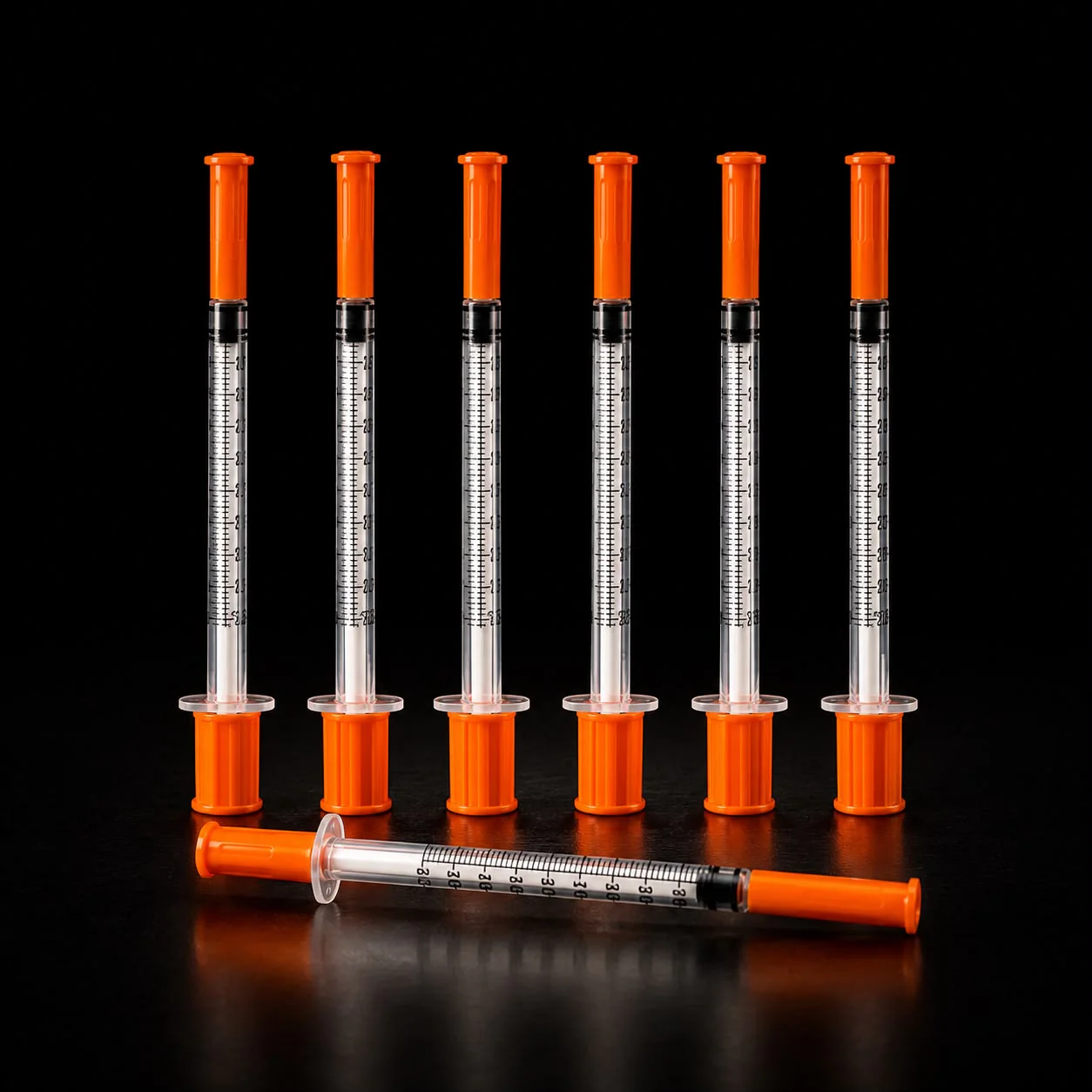
Premium Insulin Syringes – 31G x 6mm (1/4″) | 0.5cc (50 Unit) | 100 Pack
Original price was: $40.00.$30.00Current price is: $30.00.
Buy premium insulin syringes 31g 6mm for laboratory peptide reconstitution and precise subcutaneous dosing. 0.5cc U-100 barrel with 0.01mL graduations, individually sterile-packed, 100 units per pack. Minimum order $200 AUD with domestic shipping. For laboratory use only.
Buy Premium Insulin Syringes 31G 6mm for Laboratory Precision
Buy premium insulin syringes 31g 6mm for laboratory peptide reconstitution, precise volumetric measurement, and controlled subcutaneous delivery. These U-100 insulin syringes feature a 31-gauge, 6mm (1/4″) ultra-fine needle attached to a 0.5cc (50-unit) barrel with 0.01mL graduation markings. According to gauge comparison research published on ResearchGate, a 31-gauge needle has a diameter of 0.26 mm, compared to 0.31 mm for 30G and 0.41 mm for 27G, making it the thinnest standard gauge for subcutaneous research delivery.citeweb_search:18#5 This reduced diameter minimises tissue trauma while maintaining sufficient lumen diameter for smooth, consistent peptide solution delivery.
Research published in PMC demonstrates that 4mm, 6mm, and 8mm needle lengths are bioequivalent for subcutaneous pharmacokinetics in healthy adults, with maximum concentration and area under the curve showing no clinically meaningful differences between 32G×4, 32G×6, and 31G×8 needles.citeweb_search:18#0 Additional PMC research confirms that injection depths in the 5–8 mm range do not affect pharmacokinetic or glucodynamic profiles in either normal weight or obese subjects, supporting the use of shorter needles for reliable subcutaneous delivery.citeweb_search:18#6 It is critical to emphasise that these syringes are sold strictly for laboratory and research use only.
31G vs 30G Needle Research Comparison
31G vs 30G Mechanism
According to comparative research data, 30G needles offer many of the benefits of ultra-fine 31G needles but are slightly thicker at 0.31 mm versus 0.26 mm for 31G.citeweb_search:18#4 Needle size research confirms that smaller gauge needles (higher gauge numbers) are thinner and generally cause less pain upon insertion, making 31G particularly suitable for researchers requiring frequent, low-trauma administration in preclinical models.citeweb_search:18#11
For research applications, 31G vs 30G selection depends on experimental design. 31G is preferred for minimal tissue trauma, reduced bleeding, and low-pain protocols in sensitive models. 30G is preferred when working with higher-viscosity solutions or when a slightly larger bore reduces the risk of needle blockage with particulate suspensions.citeweb_search:18#4web_search:18#11
6mm vs 8mm Needle Length Research
Researchers frequently investigate 6mm vs 8mm needle length because both are standard subcutaneous lengths with distinct handling profiles. According to PMC pharmacokinetic research, 5mm and 8mm injection depths showed no apparent differences in AUC, Cmax, or glucodynamic parameters in either normal weight or obese subjects, with 90% confidence intervals within bioequivalence bounds.citeweb_search:18#6 Clinical injection research notes that 8mm needles typically require a skin fold to reduce intramuscular risk, while 6mm needles can be used with a perpendicular insertion in most adults.citeweb_search:18#12
For laboratory research, 6mm is preferred for straightforward perpendicular insertion without skin fold manipulation, reduced risk of intramuscular delivery, and improved model compliance. 8mm is preferred for protocols where a skin fold is standardised or where slightly deeper subcutaneous deposition is desired.citeweb_search:18#6web_search:18#12
0.5cc vs 0.3cc vs 1.0cc Syringe Barrel Research
The 0.5cc vs 0.3cc vs 1.0cc comparison is central to peptide dosing precision. According to peptide dosing research, all U-100 insulin syringes share the same 100-units-per-mL standard, meaning each unit equals 0.01 mL regardless of barrel size.citeweb_search:18#3 However, the practical readability and precision differ: a 0.3cc (30-unit) syringe offers the finest visual control for micro-doses below 10 units, a 0.5cc (50-unit) syringe provides the optimal balance for medium doses in the 5–50 unit range, and a 1.0cc (100-unit) syringe is best for larger volumes or high-concentration reconstitutions.citeweb_search:18#3
For research applications, 0.3cc syringes are preferred for very low-dose peptides like Ipamorelin or Semax where doses fall below 200 mcg. 0.5cc syringes are the versatile standard for medium-dose protocols including CJC-1295 No DAC, BPC-157, and GHK-Cu. 1.0cc syringes are preferred for high-volume reconstitutions or when delivering larger doses of glutathione or TB-500.citeweb_search:18#3
Insulin Syringe vs Pen Needle Research
According to peptide syringe selection research, insulin syringes with fixed needles offer integrated, low-dead-space design that minimises residual product loss between draws. Pen needles are separate components that attach to multi-dose peptide pens or vial adapters.citeweb_search:18#9 Healthline research confirms that syringes allow more flexibility when doses need to be adjusted daily based on experimental requirements, whereas pen systems are optimised for fixed-dose repeatability.citeweb_search:18#14
For laboratory research, insulin syringes are preferred for reconstituted vial protocols where dose flexibility, precise visual measurement, and minimal dead space are critical. Pen needles are preferred for multi-dose cartridge systems and high-throughput protocols where rapid needle changeout is prioritised over dose customisation.citeweb_search:18#9web_search:18#14
Premium Insulin Syringe Usage for Research
Peptide Dosing Precision
For laboratory research, the 0.5cc U-100 barrel delivers exactly 0.01 mL per unit mark. According to peptide calculator research, a 5mg vial reconstituted with 2.0 mL bacteriostatic water yields 2.5 mg/mL, meaning each unit on a U-100 syringe delivers 25 mcg.citeweb_search:18#3 A 10mg vial reconstituted with 2.0 mL yields 5.0 mg/mL, or 50 mcg per unit. This linear relationship makes U-100 insulin syringes the standard measurement tool for peptide research laboratories. All dosing calculations are for laboratory research use only.
Sterile Handling Protocol
Each syringe is individually sterile-packed and intended for single use only. Do not reuse syringes between vials or subjects. Dispose of sharps in an approved biohazard container immediately after use. Store unopened packs in a clean, dry environment away from direct sunlight. Do not use if packaging is compromised or if the needle tip is bent or damaged.
How Premium Insulin Syringes Compare to Other Research Tools
31G 6mm vs 30G 8mm
30G 8mm syringes have a slightly larger bore (0.31 mm) and longer length, requiring skin-fold technique in some models. 31G 6mm syringes have a finer bore (0.26 mm) and shorter length, enabling perpendicular insertion with minimal trauma. 30G 8mm is preferred for higher-viscosity solutions. 31G 6mm is preferred for low-trauma, frequent-dosing research. The choice depends on solution viscosity and model sensitivity.
0.5cc vs 0.3cc Syringe
0.3cc (30-unit) syringes are optimal for micro-dose research where typical draws fall below 10 units. 0.5cc (50-unit) syringes are the versatile standard for medium-dose protocols with draws in the 5–50 unit range. 0.3cc is for precision micro-dosing. 0.5cc is for general laboratory research. They are complementary inventory items.
0.5cc vs 1.0cc Syringe
1.0cc (100-unit) syringes are designed for high-volume draws and large-dose protocols. 0.5cc (50-unit) syringes offer finer visual control for medium doses and reduced dead space. 1.0cc is for bulk reconstitution or high-dose delivery. 0.5cc is for standard peptide research dosing. The choice depends on typical draw volume.
Insulin Syringe vs Regular Syringe
Regular 1mL Luer-lock syringes are general-purpose devices with detachable needles and broader graduation markings. Premium insulin syringes 31G 6mm are precision devices with fixed ultra-fine needles, U-100 unit graduations, and minimal dead space. Regular syringes are for general liquid transfer and mixing. Insulin syringes are for precise peptide dosing and subcutaneous delivery. They are not interchangeable in research protocols.
31G vs 27G Needle
27G needles have a diameter of 0.41 mm and are significantly thicker, causing more tissue trauma and discomfort. 31G needles have a diameter of 0.26 mm and are the thinnest standard gauge, minimising pain and bleeding. 27G is for viscous oil-based compounds or intramuscular research. 31G is for subcutaneous peptide research. They serve different research applications.
Insulin Syringe vs Oral Administration
Oral peptide delivery systems are studied for bypassing injection, but most peptides have oral bioavailability below 1% due to gastric degradation. 31G 6mm insulin syringes enable direct subcutaneous delivery with near-complete bioavailability for research compounds. Oral delivery is for bioavailability and absorption kinetics research. Insulin syringes are for parenteral delivery and dose-precision research. They are distinct administration research categories.
Product Specifications
Design and Performance
- Needle Gauge: 31G (0.26 mm outer diameter)
- Needle Length: 6mm (1/4 inch)
- Barrel Volume: 0.5cc (50 units / 0.5 mL)
- Graduation: U-100 standard, 1 unit = 0.01 mL
- Markings: Clear 1-unit increments for precise dosing
- Needle Type: Fixed, ultra-fine, lubricated
- Standard: ISO 8537 compliant
Safety and Packaging
- Sterility: EO gas sterilised, individually blister-packed
- Use: Single-use only
- Dead Space: Minimal integrated dead space
- Pack Size: 100 syringes per box
- Storage: Room temperature, dry environment, away from direct sunlight
- Expiry: 5 years from manufacture date when stored correctly
Shipping and Returns
We ship premium insulin syringes from our Australian facility via express domestic courier. Orders placed before 2:00 PM AEST dispatch the same business day. All syringe orders are packaged in discreet, reinforced cartons.
- Minimum order: $200 AUD
- Free shipping: Orders over $200 AUD
- Flat rate: $15 AUD for orders under $200
- Delivery time: 1 to 5 business days Australia-wide
- Returns: Unopened boxes may be returned within 30 days of delivery for store credit or replacement. We do not accept returns on opened or partially used packs due to sterility concerns. Read the full returns policy.
Frequently Asked Questions
Buy premium insulin syringes 31g 6mm for research
Pure Peptide Factory supplies premium insulin syringes 31g 6mm for laboratory peptide reconstitution and precise dosing. Each box contains 100 individually sterile-packed, single-use U-100 syringes with 0.5cc barrels. Minimum order $200 AUD.
31G vs 30G needle for peptide research
31G needles are thinner at 0.26 mm versus 0.31 mm for 30G, causing less tissue trauma and discomfort. 30G may be preferred for slightly viscous solutions. 31G is the standard for subcutaneous peptide research requiring minimal trauma.
6mm vs 8mm needle length for subcutaneous research
Pharmacokinetic research shows 6mm and 8mm needles are bioequivalent for subcutaneous delivery. 6mm enables perpendicular insertion without skin fold. 8mm may require skin fold technique. 6mm is preferred for straightforward research protocols.
0.5cc vs 1.0cc syringe for peptide dosing
0.5cc (50-unit) syringes are ideal for medium doses in the 5–50 unit range. 1.0cc (100-unit) syringes are for high-volume draws. 0.5cc offers finer visual control for typical peptide research doses. All U-100 syringes deliver 0.01 mL per unit.
How many units is 0.5cc on an insulin syringe
A 0.5cc U-100 insulin syringe holds 50 units. Each unit mark equals 0.01 mL. This is the standard barrel size for medium-dose peptide research protocols.
Can these syringes be reused
No. These syringes are single-use only. Reuse compromises sterility, blurs graduation markings, and dulls the ultra-fine needle tip. Always use a new sterile syringe for each draw and administration.
Do you ship outside Australia
Currently, we only ship to Australian addresses. We do not export medical devices due to varying international customs and regulatory requirements.
How do I calculate peptide units on a U-100 syringe
Divide total milligrams by reconstitution millilitres to get mg/mL. Then divide by 100 to get mg per unit. For example, 5mg in 2mL = 2.5mg/mL = 0.025mg (25mcg) per unit. Use our peptide calculator for exact conversion.
Related products
-
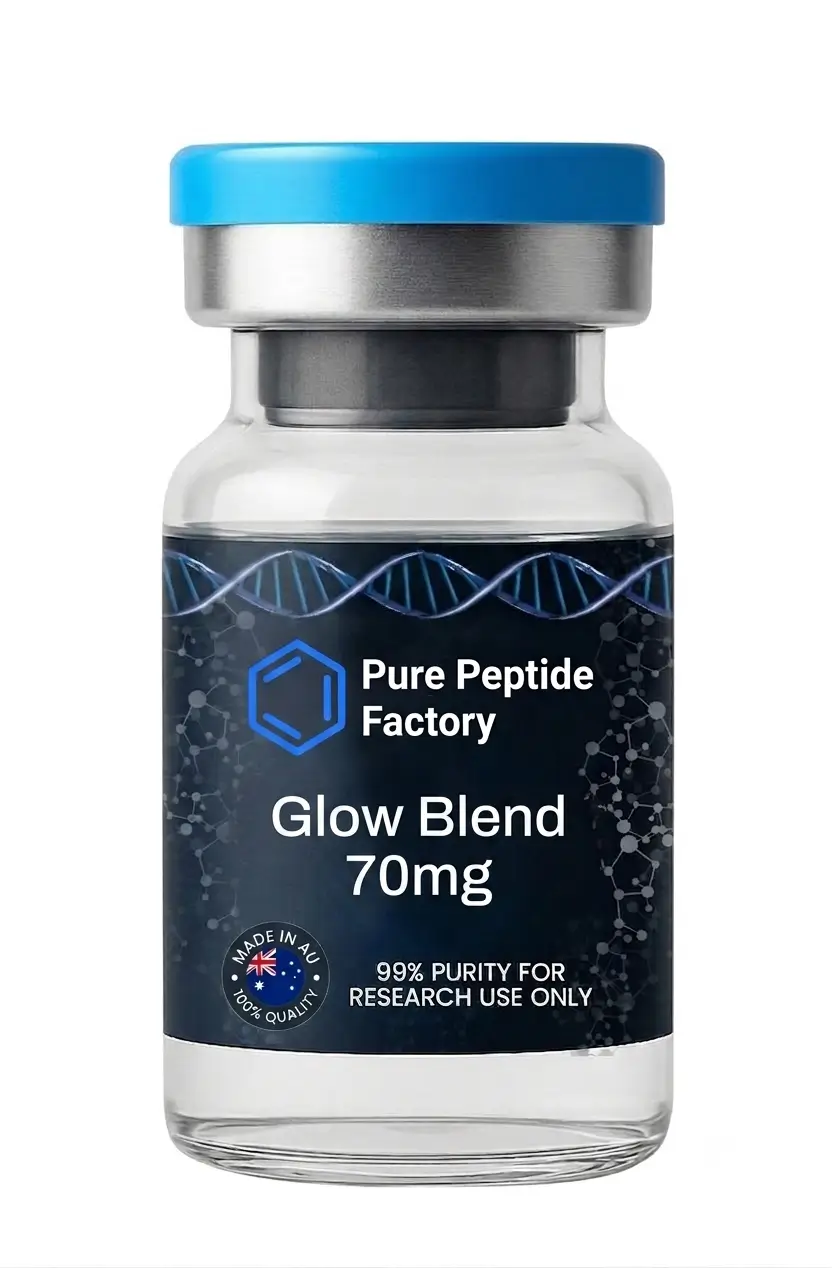
Glow Blend 70mg
Original price was: $168.00.$158.00Current price is: $158.00.
Reviews
There are no reviews yet.