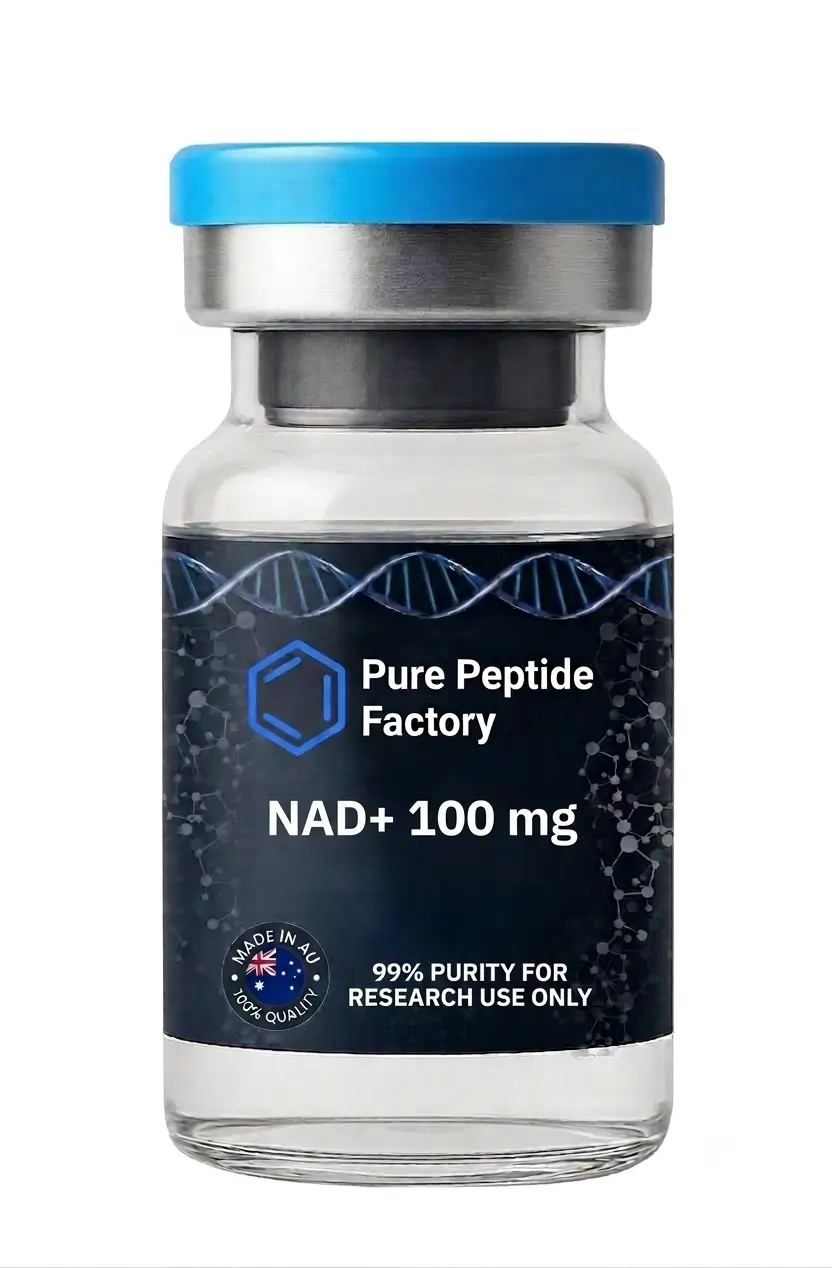
NAD+ peptide 100 mg
Price range: $70.00 through $90.00
Buy nad peptide 100mg research-grade coenzyme for laboratory applications in cellular energy, sirtuin activation, and DNA repair pathways. Available in 100mg lyophilised vials with HPLC-verified purity. Minimum order $200 AUD with domestic shipping.
Buy NAD Peptide 100mg Research and Mechanism
Buy nad peptide 100mg for laboratory research into cellular bioenergetics, sirtuin signalling, and DNA repair machinery. Nicotinamide adenine dinucleotide (NAD+) is an essential redox coenzyme composed of two nucleotides joined through their phosphate groups, with an adenine base on one side and a nicotinamide base on the other. According to research published in PMC, NAD+ is involved in over 500 enzymatic reactions and serves as a critical substrate for sirtuins (SIRT1-7), PARP enzymes, and CD38, regulating everything from mitochondrial function to genomic stability.citeweb_search:14#2 NAD+ levels decline approximately 50% by age 50, impairing mitochondrial respiration, reducing sirtuin activity, and compromising DNA repair capacity.citeweb_search:15#4 This decline profile makes NAD+ a central research molecule for studying age-related metabolic dysfunction, cellular senescence, and redox homeostasis in preclinical models.
Research published in PMC on regenerative medicine demonstrates that NAD+ replenishment improves lifespan and healthspan in ataxia telangiectasia models via enhanced mitophagy and DNA repair pathways.citeweb_search:14#3 Head-to-head research in Nature Metabolism compared three NAD+ precursors (NR, NMN, and Nam) in a randomised four-arm human trial, finding that NR and NMN are comparable in their ability to chronically increase baseline whole-blood NAD+ levels, while Nam provides only an acute transient effect.citeweb_search:14#0 It is critical to emphasise that NAD+ peptide is not approved by the TGA for human use. It is sold strictly for in vitro and laboratory research use only.
NAD+ vs NMN Research Comparison
NAD+ vs NMN Mechanism
According to head-to-head research published in Nature Metabolism, NMN is a ribonucleotide that must be converted to NR before entering most cells, as cell membranes are largely impermeable to phosphorylated molecules.citeweb_search:14#0 PMC research on precursor comparisons confirms that NMN is not taken directly into the cell but is first metabolised extracellularly into NR via the CD73 enzyme, then converted back to NMN intracellularly via NR kinases before finally becoming NAD+.citeweb_search:14#1 This introduces additional metabolic steps that may reduce conversion efficiency compared to direct NAD+ or NR administration.
For research applications, NAD+ vs NMN selection depends on experimental design. NMN is preferred for studying the salvage pathway, CD73-mediated extracellular processing, and precursor-conversion kinetics. Direct NAD+ is preferred for research requiring immediate coenzyme availability, sirtuin substrate studies, and PARP enzyme fuel investigations without conversion bottlenecks.citeweb_search:14#1web_search:15#1
NAD+ vs NR Research
Researchers frequently investigate NAD+ vs NR because nicotinamide riboside is the most clinically studied NAD+ precursor. According to PMC research on NR therapeutic uses, NR enters cells directly via equilibrative nucleoside transporters without requiring prior conversion, and has been shown to increase NAD+ levels in the liver of mice with greater oral bioavailability than NAM or NA.citeweb_search:15#14 The Nestlé head-to-head trial found that NR and NMN are comparable in chronic NAD+ elevation, but both rely substantially on gut microbiome conversion to nicotinic acid (NA) for their systemic effects.citeweb_search:14#0 For laboratory research, NR is positioned for precursor-bioavailability and microbiome-interaction studies, while direct NAD+ peptide 100mg is positioned for immediate coenzyme activity, redox-cycling, and direct enzyme-substrate research.
NAD+ vs Glutathione Research
The NAD+ vs glutathione comparison is central to cellular redox research. According to research published in PMC, both systems are interconnected through cellular metabolism, but serve distinct primary roles. NAD+/NADH is the central electron carrier for glycolysis, the citric-acid cycle, and mitochondrial energy metabolism. Glutathione (GSH/GSSG) is the master antioxidant tripeptide that neutralises peroxides and participates in phase II detoxification.citeweb_search:15#8 Comparative clinical data notes that glutathione reductase—the enzyme that converts oxidised glutathione (GSSG) back to reduced glutathione (GSH)—primarily uses NADPH, not NAD+ directly, as its reducing power, establishing a metabolic bridge between the two systems.citeweb_search:15#5 For laboratory research, NAD+ is positioned for bioenergetics, sirtuin/PARP studies, and redox-cycling research. Glutathione is positioned for antioxidant defence, detoxification conjugation, and oxidative stress biomarker research. They are complementary, not interchangeable, research tools.
NAD+ Peptide Benefits in Research
Research applications involving NAD+ peptide benefits span metabolic biology, longevity science, and genomic maintenance. According to comprehensive PMC research, NAD+ is investigated for its role in restoring mitochondrial function, ameliorating metabolic syndrome and insulin sensitivity, reducing neurodegeneration, supporting cardiovascular health, and influencing life extension through sirtuin-mediated pathways.citeweb_search:14#2 Regenerative medicine research confirms that NAD+ fuels PARP enzymes responsible for single-strand DNA break repair, and that depletion leads to accumulated DNA damage and accelerated cellular aging.citeweb_search:14#3 Additional research directions include NAD+-dependent activation of the mitochondrial unfolded protein response (UPRmt), modulation of inflammation through NF-κB pathways, and support for autophagy machinery.citeweb_search:14#3 These effects are observed in preclinical and clinical research models; NAD+ peptide has not been approved for human therapeutic use.
NAD+ Peptide 100mg Dosage and Reconstitution
NAD+ 100mg Dose for Research Protocols
For laboratory research, NAD+ peptide 100mg is typically supplied as a 100mg lyophilised powder. According to clinical bioavailability research, intravenous NAD+ achieves near-100% bioavailability with immediate elevation of blood NAD+ levels, while oral capsules typically achieve only 5–15% bioavailability due to gastrointestinal degradation.citeweb_search:14#4 Typical laboratory reconstitution uses 10.0 mL of bacteriostatic water to yield approximately 10 mg/mL. At this concentration, 1 unit on a U-100 insulin syringe (0.01 mL) delivers approximately 100 micrograms. Reference research protocols have investigated a wide range of concentrations for in vitro sirtuin activation, PARP activity assays, and mitochondrial respiration studies. All dosing parameters are for laboratory research use only and must be calibrated to specific assay requirements.
Reconstitution Guide
Remove the vial from freezer storage and allow it to equilibrate to room temperature for 15 to 20 minutes. Draw 10.0 mL of bacteriostatic water into a sterile syringe and inject slowly down the inner vial wall to minimise foaming. Gently swirl until fully dissolved. Do not shake vigorously. Label with the reconstitution date and store at 2 to 8 degrees C protected from light. Use within 14 days. Do not freeze reconstituted solution.
How NAD+ Compares to Other Research Compounds
NAD+ vs NMN
NMN is a nicotinamide mononucleotide precursor that must be converted to NR extracellularly before entering cells and being rebuilt into NAD+. NAD+ peptide 100mg is the direct coenzyme substrate for sirtuins, PARPs, and redox reactions without conversion steps. NMN is preferred for salvage-pathway and precursor-kinetics research. NAD+ peptide 100mg is preferred for direct enzyme-substrate, sirtuin activation, and immediate redox-cycling research. The choice depends on whether the research question requires precursor metabolism or direct coenzyme activity.
NAD+ vs NR
NR is a nicotinamide riboside precursor that enters cells directly via nucleoside transporters and is converted to NAD+ intracellularly. NAD+ peptide 100mg is the active coenzyme itself, bypassing all precursor conversion steps. NR is preferred for bioavailability, microbiome-conversion, and precursor-comparison research. NAD+ peptide 100mg is preferred for direct PARP fuel, sirtuin substrate, and redox-status research. They are related but distinct research tools.
NAD+ vs Glutathione
Glutathione is a tripeptide antioxidant studied for detoxification, phase II conjugation, and peroxide neutralisation. NAD+ peptide 100mg is a dinucleotide coenzyme studied for energy metabolism, sirtuin activation, and DNA repair. Glutathione is positioned for antioxidant defence and oxidative stress research. NAD+ peptide 100mg is positioned for bioenergetics, genomic maintenance, and metabolic signalling research. They operate through interconnected but distinct redox systems.
NAD+ vs Epitalon
Epitalon is a pineal tetrapeptide studied for telomerase activation, telomere maintenance, and circadian rhythm regulation. NAD+ peptide 100mg is a coenzyme studied for cellular energy production, sirtuin activation, and DNA repair. Epitalon addresses chromosomal stability through telomere biology. NAD+ peptide 100mg addresses metabolic integrity through redox and enzyme-substrate pathways. These are entirely different longevity research categories.
NAD+ vs CJC-1295 No Dac
CJC-1295 No DAC is a GHRH analog studied for growth hormone axis stimulation and pulsatile GH release. NAD+ peptide 100mg is a coenzyme studied for cellular bioenergetics and metabolic regulation. CJC-1295 No DAC addresses the somatotropic endocrine axis. NAD+ peptide 100mg addresses intracellular redox and energy metabolism. These are entirely different research categories.
NAD+ vs BPC-157
BPC-157 is a synthetic pentadecapeptide studied for tissue regeneration, wound healing, and angiogenesis through growth factor pathways. NAD+ peptide 100mg is a coenzyme studied for mitochondrial function, DNA repair, and sirtuin-mediated longevity signalling. BPC-157 is for structural repair research. NAD+ peptide 100mg is for metabolic and genomic maintenance research. They are distinct research compounds.
NAD+ vs Alpha Lipoic Acid
Alpha lipoic acid is a disulfide compound studied for its ability to regenerate glutathione, vitamin C, and vitamin E through redox cycling. NAD+ peptide 100mg is the central coenzyme for mitochondrial respiration, sirtuin activation, and PARP-mediated DNA repair. Alpha lipoic acid is positioned for mitochondrial antioxidant and metal-chelating research. NAD+ peptide 100mg is positioned for bioenergetics and genomic stability research. They are distinct but synergistic antioxidant tools.
Product Specifications
Purity and Analysis
- Content: 100mg lyophilised powder
- Full Name: Nicotinamide Adenine Dinucleotide (oxidised form)
- Molecular Formula: C₂₁H₂₇N₇O₁₄P₂
- Molecular Weight: 663.43 g/mol
- Purity: Greater than or equal to 98% by HPLC
- Appearance: White to off-white lyophilised powder
- Source: Synthetic, manufactured via enzymatic synthesis
Each batch is independently tested. Request the Certificate of Analysis (COA) for your specific batch number to verify purity, mass spec, and chromatography data.
Storage and Handling
- Lyophilised storage: -20 degrees C, protected from light and moisture
- Shelf life (unreconstituted): 24 months when stored correctly
- Handling: Use sterile technique. Avoid repeated freeze-thaw cycles
Shipping and Returns
We ship NAD+ peptide from our Australian facility via express domestic courier. Orders placed before 2:00 PM AEST dispatch the same business day. All peptide orders are packaged in insulated, discreet packaging with cold-chain protection where required.
- Minimum order: $200 AUD
- Free shipping: Orders over $200 AUD
- Flat rate: $15 AUD for orders under $200
- Delivery time: 1 to 5 business days Australia-wide
- Returns: Unopened vials may be returned within 30 days of delivery for store credit or replacement. We do not accept returns on reconstituted or opened products due to stability concerns. Read the full returns policy.
Frequently Asked Questions
Buy nad peptide 100mg for research
Pure Peptide Factory supplies NAD+ peptide as a research-grade coenzyme for laboratory applications. Each vial contains 100mg lyophilised powder with HPLC verification and a Certificate of Analysis. Minimum order $200 AUD.
NAD+ vs NMN for research
NMN is a precursor that must be converted to NR extracellularly before entering cells and being rebuilt into NAD+. Direct NAD+ is the active coenzyme substrate for sirtuins and PARP enzymes without conversion steps. NMN is for precursor-pathway research; NAD+ is for direct enzyme-substrate and redox research.
NAD+ peptide dosage for research
Research protocols typically reconstitute a 100mg vial with 10.0 mL bacteriostatic water to yield 10 mg/mL. Reference protocols span a wide range depending on assay type, from nanomolar concentrations for in vitro sirtuin studies to higher concentrations for mitochondrial respiration research. All dosing is for laboratory research only.
NAD+ vs NR which is better
Neither is universally better. NR is a precursor with direct cellular entry via nucleoside transporters and extensive clinical bioavailability data. NAD+ is the direct active coenzyme. NR is preferred for precursor-comparison and microbiome-conversion research. NAD+ is preferred for direct redox-cycling, PARP fuel, and sirtuin-substrate research.
NAD+ vs glutathione mechanism
NAD+ is the central coenzyme for mitochondrial energy metabolism and electron transfer. Glutathione is the master antioxidant tripeptide for peroxide neutralisation and detoxification. They are interconnected through NADPH-dependent glutathione reductase but serve distinct primary research roles.
Is NAD+ approved for human use
No. NAD+ peptide is strictly for research and laboratory use. It is not approved by the TGA for human consumption, therapeutic application, or clinical use.
Do you ship outside Australia
Currently, we only ship to Australian addresses. We do not export peptides due to varying international customs regulations.
How do I verify the purity of my batch
Every batch ships with a unique batch number. Enter this number on our COA lookup page to download the HPLC and mass spec report for your specific vial.
| Dosage | 100mg, 500mg, 1000mg |
|---|
Reviews
There are no reviews yet.