
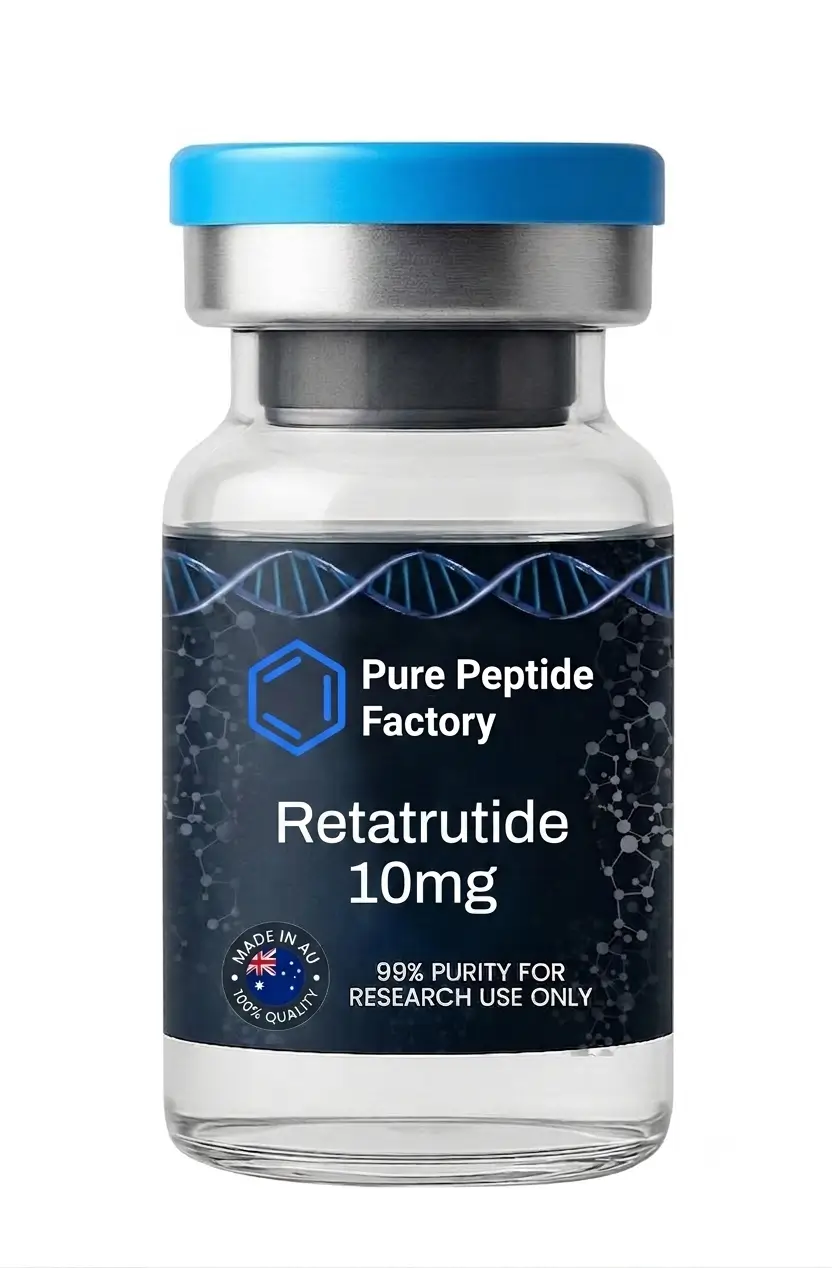
Retatrutide 10mg
Price range: $60.00 through $380.00
Retatrutide research-grade triple agonist for laboratory applications. Available for Australian research institutions studying GIP, GLP-1, and glucagon receptor pathways. Minimum order $200 AUD with domestic shipping. Not for human consumption.
Retatrutide Research and Mechanism
Retatrutide is a synthetic 39-amino-acid peptide-based triple agonist targeting the glucose-dependent insulinotropic polypeptide (GIP), glucagon-like peptide-1 (GLP-1), and glucagon receptors. Unlike single-pathway agonists, retatrutide activates all three receptors to produce synergistic metabolic effects. The GLP-1 component suppresses appetite and slows gastric emptying, the GIP component enhances glucose-dependent insulin secretion, and the glucagon receptor component increases energy expenditure and fatty acid oxidation. A landmark Phase 2 trial published in The New England Journal of Medicine demonstrated that participants receiving 12 mg of retatrutide achieved a mean weight reduction of 24.2 percent after 48 weeks, with the trajectory indicating that a plateau had not yet been reached.
More recent Phase 3 data released by Eli Lilly in 2026 suggests efficacy up to 28.3 percent weight reduction at 80-plus weeks. A systematic review and meta-analysis published in PMC confirmed significant improvements in HbA1c, fasting plasma glucose, blood pressure, and lipid profiles across retatrutide treatment groups. A network meta-analysis in PMC found that retatrutide demonstrated superior absolute and percentage weight reduction compared to tirzepatide, though with a higher frequency of gastrointestinal adverse events. All data described are derived from clinical trials and peer-reviewed literature. Retatrutide is not approved by the TGA or FDA and is sold strictly for in vitro and laboratory research use only.
Retatrutide Australia Regulatory Status
Retatrutide is not TGA-approved in Australia and has no commercial availability through pharmacies or medical channels. According to regulatory tracking data, Australia has limited Phase 3 trial sites in major cities, with TGA approval projected for 2028 and PBS listing potentially following in 2029 to 2030. For researchers asking retatrutide how to get access for laboratory protocols, the compound is available as a research reference material through specialised Australian peptide suppliers for analytical and assay development purposes only. It cannot be supplied for human administration, clinical use, or diagnosis.
Retatrutide Dosage and Clinical Data
Retatrutide Dosage in Clinical Trials
Phase 2 trials evaluated retatrutide at 1 mg, 4 mg, 8 mg, and 12 mg administered via subcutaneous injection once weekly. The dose-escalation protocol started at 2 mg or 4 mg and titrated upward to improve tolerability. Phase 3 trials are evaluating 4 mg, 9 mg, and 12 mg dose arms. For researchers investigating retatrutide dosage in preclinical or analytical contexts, reference standards are typically reconstituted at concentrations appropriate for receptor binding assays, cell culture work, or chromatographic calibration. A common laboratory reconstitution uses 1.0 to 2.0 mL of bacteriostatic water per vial to achieve a measurable concentration for instrument validation. Gently swirl until fully dissolved. Do not shake vigorously.
Reconstitution and Storage
Remove the vial from freezer storage and allow it to equilibrate to room temperature for 15 to 20 minutes. Draw 1.0 to 2.0 mL of bacteriostatic water into a sterile syringe and inject slowly down the inner vial wall to minimise foaming. Label with the reconstitution date and store at 2 to 8 degrees C protected from light. Use within 14 to 21 days. Do not freeze reconstituted solution. Lyophilised retatrutide should be stored at -20 degrees C protected from light and moisture with a shelf life of 24 months when handled correctly.
Retatrutide Side Effects
Clinical trial data published in NEJM and summarised in PMC indicate that the most common retatrutide side effects are gastrointestinal and dose-dependent. These include nausea, diarrhoea, vomiting, constipation, and mild stomach discomfort. A dose-dependent increase in heart rate was observed, peaking at 24 weeks and declining thereafter. Phase 3 data noted a safety signal for dysesthesia, an abnormal skin sensation, at higher doses. Other observed events include upper respiratory tract infections, urinary tract infections, and gallbladder-related effects. No cases of severe hypoglycaemia or medullary thyroid carcinoma were reported in Phase 2. These safety profiles are documented for research reference only and do not constitute medical guidance.
How Retatrutide Compares to Other Research Compounds
Retatrutide vs Tirzepatide
Tirzepatide is a dual GIP and GLP-1 receptor agonist approved by the TGA for type 2 diabetes, weight management, and obstructive sleep apnoea. Retatrutide adds glucagon receptor agonism to create a triple mechanism. According to network meta-analysis data, retatrutide produced greater absolute weight reduction than tirzepatide, though with a higher incidence of adverse events. Tirzepatide is available by prescription in Australia; retatrutide remains investigational. For researchers studying incretin biology, retatrutide offers a more complex receptor profile compared to the dual agonist tirzepatide.
Retatrutide vs Semaglutide
Semaglutide is a selective GLP-1 receptor agonist approved for diabetes and weight management. Retatrutide targets three hormone receptors instead of one. According to Forbes Health, preliminary data suggests retatrutide may produce more potent weight loss effects than semaglutide due to the additional GIP and glucagon activity. Semaglutide is a proven therapeutic with established protocols; retatrutide is an experimental compound for research applications only.
Retatrutide vs AOD-9604
AOD-9604 is a modified HGH fragment studied for direct lipolysis via beta-3 adrenergic receptor pathways without significant IGF-1 elevation. Retatrutide is a large peptide-based biologic that acts on endocrine receptors to regulate systemic glucose, appetite, and energy expenditure. AOD-9604 is positioned for adipose tissue metabolism research, while retatrutide is studied for broader metabolic disease mechanisms. They are not interchangeable research tools.
Retatrutide vs 5 Amino 1mq
5 amino 1mq is a small molecule NNMT inhibitor that may elevate NAD+ and activate SIRT1 to influence metabolic efficiency at the enzymatic level. Retatrutide is a peptide-based triple hormone receptor agonist that operates through endocrine signalling. 5 amino 1mq is studied for cellular energy balance in adipose tissue, while retatrutide is investigated for systemic metabolic regulation. These compounds address different mechanistic layers and may be used in complementary research panels.
Retatrutide vs MOTS-c
MOTS-c is a mitochondrial-derived peptide that activates AMPK and regulates cellular energy homeostasis through stress response pathways. Retatrutide is an endocrine hormone analog that acts on pancreatic and gut receptors. MOTS-c is studied for mitochondrial biogenesis and exercise adaptation, while retatrutide is studied for incretin receptor pharmacology. They represent entirely different research categories.
Retatrutide vs Hgh Fragment 176 191
Hgh fragment 176 191 is a peptide fragment targeting the lipolytic domain of human growth hormone, studied for fat metabolism without IGF-1 effects. Retatrutide is a triple agonist with no structural relationship to growth hormone. Hgh fragment 176 191 is investigated for subcutaneous fat reduction, while retatrutide is investigated for comprehensive metabolic disease mechanisms. They are distinct research compounds.
What Is Retatrutide in Research Context
For researchers asking what is retatrutide, it is a synthetic peptide-based triple hormone receptor agonist developed by Eli Lilly under the designation LY3437943. The molecule consists of a 39-amino-acid peptide sequence with a C20 fatty diacid moiety attached via a linker to Lys20, enabling albumin binding and an extended half-life suitable for weekly administration protocols in clinical research. The triple agonism at GIP, GLP-1, and glucagon receptors makes retatrutide a unique pharmacological probe for studying energy homeostasis, substrate utilisation, and metabolic disease mechanisms in controlled laboratory settings.
Product Specifications
Purity and Analysis
- Purity: Greater than or equal to 98% by HPLC
- Chemical class: Triple GIP/GLP-1/Glucagon receptor agonist
- Sequence: 39-amino-acid peptide with C20 fatty diacid moiety
- Molecular Formula: C225H348N48O68
- Molecular Weight: 4813.5 g/mol
- Appearance: White to off-white lyophilised powder
- Source: Synthetic, manufactured via solid-phase peptide synthesis
Each batch is independently tested. Request the Certificate of Analysis (COA) for your specific batch number to verify purity, mass spec, and chromatography data.
Storage and Handling
- Lyophilised storage: -20 degrees C, protected from light and moisture
- Shelf life (unreconstituted): 24 months when stored correctly
- Handling: Use sterile technique. Avoid repeated freeze-thaw cycles
Shipping and Returns
We ship retatrutide from our Australian facility via express domestic courier. Orders placed before 2:00 PM AEST dispatch the same business day. All orders are packaged in insulated, discreet packaging with cold-chain protection where required.
- Minimum order: $200 AUD
- Free shipping: Orders over $200 AUD
- Flat rate: $15 AUD for orders under $200
- Delivery time: 1 to 5 business days Australia-wide
- Returns: Unopened vials may be returned within 30 days of delivery for store credit or replacement. We do not accept returns on reconstituted or opened products due to stability concerns. Read the full returns policy.
Frequently Asked Questions
What is retatrutide
Retatrutide is a synthetic triple agonist targeting GIP, GLP-1, and glucagon receptors. It is an investigational compound in Phase 3 clinical trials with no TGA or FDA approval. It is available for laboratory research use only.
Peptide retatrutide what is it
Peptide retatrutide is a 39-amino-acid peptide with a fatty acid side chain that acts as a triple hormone receptor agonist. It is not a simple peptide but a complex biologic conjugate designed for extended half-life and multi-receptor activity.
Retatrutide how to get for research
Australian research institutions can source retatrutide through Pure Peptide Factory as a reference material for analytical and assay development work. We require a minimum order of $200 AUD and offer domestic shipping. This product is for laboratory research only.
Buy retatrutide australia
Pure Peptide Factory supplies retatrutide to Australian research laboratories and institutions for in vitro and analytical applications. We do not supply retatrutide for human use, clinical trials, or diagnosis. All orders require institutional or research verification.
Buy retatrutide
You can buy retatrutide research material through our Australian facility. We stock lyophilised vials with HPLC verification and provide Certificates of Analysis for every batch. Minimum order $200 AUD.
Retatrutide side effects
Clinical trial data indicates gastrointestinal events are most common, including nausea, diarrhoea, vomiting, and constipation. Other observed effects include dose-dependent heart rate increases and dysesthesia. These data are for research reference only.
Retatrutide dosage in research
Clinical trials used weekly subcutaneous doses of 1 mg to 12 mg. For laboratory research, reconstitution concentrations depend on your assay requirements. Typical laboratory protocols use 1.0 to 2.0 mL of bacteriostatic water per vial for analytical calibration.
Is retatrutide approved for human use
No. Retatrutide is strictly for research and laboratory use. It is not approved by the TGA for human consumption, therapeutic application, or clinical use.
Do you ship outside Australia
Currently, we only ship to Australian addresses. We do not export research compounds due to varying international customs regulations.
How do I verify the purity of my batch
Every batch ships with a unique batch number. Enter this number on our COA lookup page to download the HPLC and mass spec report for your specific vial.
| Dosage | 5mg, 10mg, 15mg, 20mg, 30mg, 40mg, 50mg, 60mg, 100mg |
|---|
Reviews
There are no reviews yet.